Barium silicate (BaSiO3), also known as barium metasilicate, is an important barium-containing inorganic compound built from barium (Ba), silicon (Si) and oxygen (O) in a Ba:Si:O atomic ratio of 1:1:3. It normally occurs as colorless orthorhombic crystals or as a white powder, and is widely used in optical glasses, ceramic glazes, phosphor host lattices and specialty coatings, where it underpins the manufacture of optical devices, lighting products and fine inorganic materials.
As a solid inorganic compound, barium silicate is chemically stable and therefore easy to store, weigh and charge into production equipment, making it well suited to large-scale industrial use. It has a high melting point of 1604 °C, which underpins good thermal stability, and a relatively high refractive index of about 1.67, satisfying the refractive-index requirements of a range of optical materials.
In terms of solubility, barium silicate is insoluble in water but dissolves in acids, and it shows good weatherability. Industrial-grade barium silicate is produced mainly by the high-temperature solid-state reaction of barium carbonate (BaCO3) with quartz sand (SiO2). Because both raw materials are abundantly available and the process is well established, careful control of raw-material purity and calcination temperature yields products with stable properties and good batch-to-batch reproducibility.
It should be noted that barium compounds are toxic to some degree. During production and use, personnel should take appropriate dust-control measures to prevent inhalation and accidental ingestion, and barium-containing waste should be collected and managed in accordance with applicable regulations to ensure safety and compliance.
Barium silicate (normally BaSiO3) can serve as a component of barium-containing glass and ceramic systems. In rare-earth-doped luminescent materials, BaSiO3 can act as a host lattice: BaSiO3:Eu2 emits yellow luminescence at about 555 nm under ultraviolet (UV) excitation, which makes it a candidate for spectral tuning in UV-chip-based white light-emitting diodes (LEDs). Its use as a down-conversion material in dye-sensitized solar cells (DSSCs) has also been investigated, although this work remains largely at the stage of materials research and validation.
In the field of luminescent materials, barium silicate—with its stable crystal structure and relatively high transparency—is an excellent host lattice for rare-earth ions. Barium silicate phosphors doped with divalent europium (BaSiO3:Eu2+), for example, can supply the yellow spectral component in white LEDs that is difficult to obtain from calcium silicate (CaSiO3) or strontium silicate (SrSiO3) systems, making them useful for adjusting the correlated color temperature (CCT) of warm-white LEDs. BaSiO3:RE3+ phosphors (RE=Sm or Eu) have also been synthesized by the high-temperature solid-state route; X-ray diffraction (XRD) data show that the BaSiO3 crystal structure is retained irrespective of the type or concentration of the activator ion.
Barium silicate can also serve as an optically functional material in solar cells. BaSiO3:Eu2+ shows strong UV absorption and broad visible emission: by converting high-energy UV photons into lower-energy visible photons, it can act as a down-conversion layer in DSSCs and thereby improve the device‘s utilization of UV light.
Barium silicate is also dimorphic: it undergoes an α-to-β phase transition at about 990°C. The final crystal form depends on the synthesis conditions and thermal history, which offers scope for tuning material properties through process control.
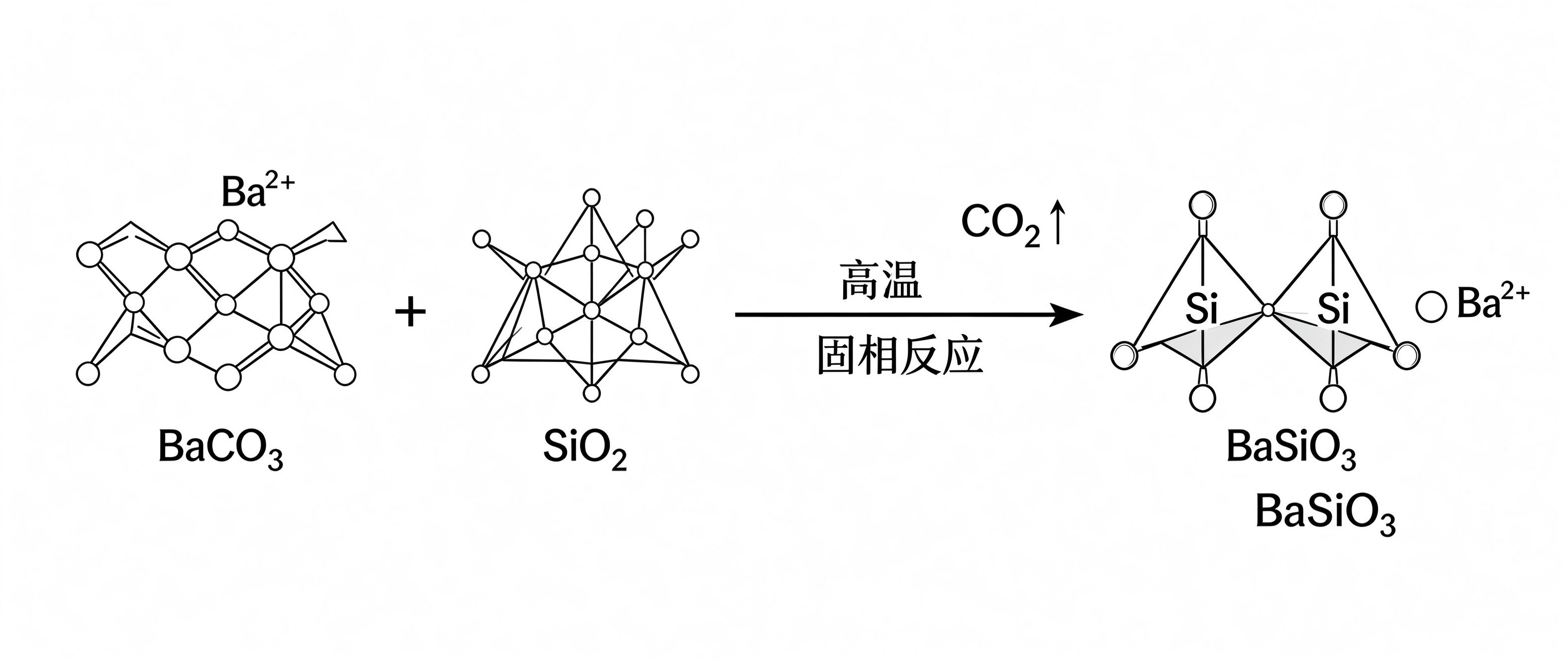
Figure 1. Schematic of the high-temperature solid-state synthesis reaction of barium silicate.
Barium silicate combines the practical advantages of a solid powder that is easy to weigh and charge, good thermal stability and a relatively high refractive index, and it can be used both as a phosphor host lattice and as an optically functional material—giving it a distinctive place among inorganic functional materials.
Guangxi Titan New Materials Technology Co., Ltd. specializes in metal compounds and fine inorganic functional materials, and is committed to supplying high-quality products and services for research and development as well as industrial applications. Universities, research institutes, enterprises and industry partners are welcome to get in touch to discuss collaboration and to explore the application potential of inorganic functional materials, driving both technological innovation and industrial development.