The 2026 Nobel Prize in Chemistry was awarded to French chemist Henri B. Kagan and Japanese chemist Kenso Soai for their discovery of non?linear effects and autocatalysis in asymmetric organic synthesis. These studies have not only deepened our understanding of how chiral molecules form but have also provided important insights into why biological systems favor one molecular configuration over another.
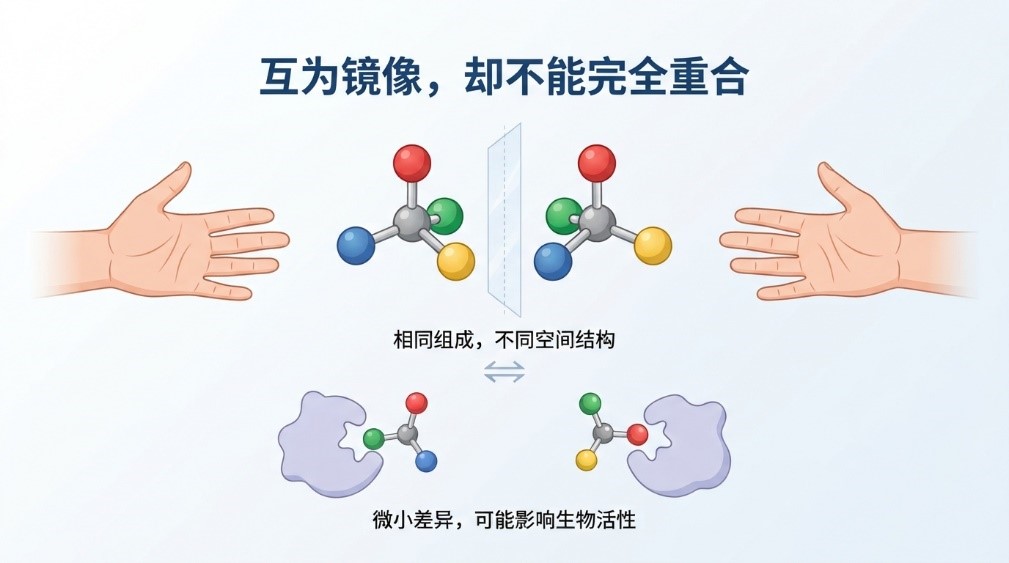
The term “chirality” derives from the Greek word for “hand.” A person‘s left and right hands are mirror images of each other, yet they cannot be superimposed by simply rotating one of them. A similar phenomenon occurs in the molecular world: some molecules have two spatial configurations that are mirror images of each other but cannot be superimposed; these two forms are known as enantiomers.
These two molecules have the same atomic composition and connectivity, yet they may exhibit different biological properties. For example, enzymes and receptors in the human body have specific three?dimensional structures and may differ significantly in their ability to recognize different enantiomers. Therefore, in drug synthesis, controlling molecular chirality is often closely linked to a drug‘s activity, safety, and metabolism.
Kagan‘s research revealed nonlinear effects in asymmetric synthesis: the enantiomeric composition of a catalyst does not always correlate linearly with that of the final product. Kenso Soai‘s studies of asymmetric autocatalysis demonstrated that a chiral product can promote its own formation, thereby amplifying even a small initial chiral imbalance. These findings have opened up new avenues for investigating how chirality arises, is propagated, and is amplified.
In organic chemistry, chirality is generally associated with the three?dimensional structure of a molecule. A common example is a tetrahedral carbon atom bonded to four different substituents; such an atom is known as a chiral center. However, chirality is not limited to carbon atoms: axial chirality, helical chirality, and metal?centered chirality in metal complexes are also important areas of research.
One of the central challenges in asymmetric organic synthesis is how to efficiently synthesize compounds with the desired configuration. Conventional methods can obtain the desired enantiomer through the resolution of a racemic mixture, but this often requires additional separation steps and can limit the efficient use of starting materials. By contrast, asymmetric catalysis can directly establish or control chiral centers during a reaction, favoring the formation of the desired configuration.
The key is to create a chiral environment within the reaction system: through steric effects, electronic effects, coordination interactions, and other intermolecular interactions, the catalyst creates different activation barriers for the two possible reaction pathways, thereby resulting in varying degrees of stereoselectivity. This approach to stereochemical control has become an important technological foundation for the synthesis of modern pharmaceuticals, pesticides, fragrances, and fine chemicals.
Among the many asymmetric catalytic systems, chiral transition?metal complexes hold a particularly important position. Such catalysts typically consist of a transition?metal center and one or more chiral ligands. The metal center can activate reactants such as hydrogen, alkenes, and carbonyl compounds, while the chiral ligand creates an asymmetric environment around the metal, thereby favoring the formation of products with a particular configuration.
A classic example is the rhodium–DIPAMP chiral catalyst system. In the 1970s, William S. Knowles combined chiral phosphine ligands with rhodium complexes for asymmetric hydrogenation, providing an important route to the highly selective synthesis of intermediates for levodopa (L?DOPA). This work helped advance the industrial application of asymmetric catalysis and was an important contribution to the achievements for which Knowles received the 2001 Nobel Prize in Chemistry.
Another representative system is the ruthenium–BINAP catalyst system. Ryoji Noyori and his co?workers developed a range of ruthenium?catalyzed asymmetric hydrogenation methods, enabling substrates such as ketones to be converted into chiral alcohols with high selectivity. Such reactions are widely used in the production of pharmaceutical intermediates and fine chemicals, and also highlight the advantages of chiral metal catalysts in terms of efficiency, selectivity, and process control.
In recent years, researchers have also been exploring a new design concept: chiral?at?metal catalysts. Unlike the conventional “metal center plus chiral ligand” approach, these complexes can derive their chirality directly from the spatial arrangement of ligands around the metal center. Related systems based on metals such as rhodium, iridium, and ruthenium have shown promise in asymmetric Lewis acid catalysis, photocatalysis, and other transformations. This opens up new possibilities for designing catalysts with novel structures and excellent selectivity.
From the discovery of chiral molecules and the development of asymmetric catalysis to the emergence of chiral?at?metal complexes, chemists have continually explored ways to achieve precise control over molecular geometry at the molecular level. Research on nonlinear effects and asymmetric autocatalysis, recognized by the Nobel Prize in Chemistry, has further elucidated how small chiral imbalances can be amplified.
The value of chiral catalysts lies not only in their ability to produce molecules with a specific configuration, but also in their potential to improve reaction selectivity, reduce material waste, and offer greater flexibility in synthesis. With the development of new metal complexes and related catalytic technologies, chiral catalysis is expected to continue driving progress in medicinal chemistry, fine chemical manufacturing, and green synthesis.
As a company specializing in organometallic compounds, Guangxi Titan New Material Technology Co., Ltd. is committed to developing and supplying organometallic compounds and chiral catalyst products, while closely following advances in metal coordination chemistry and asymmetric catalysis. Building on its expertise in organometallic compounds, Guangxi Titan New Material Technology Co., Ltd. offers chiral catalyst products, providing additional options for scientific research, reaction process development, and fine chemical synthesis. Guangxi Titan New Material Technology Co., Ltd. will continue to follow technological advances in organometallic chemistry and chiral catalysis and actively explore the potential applications of its products in highly selective synthesis.
We warmly welcome research institutions, universities, companies, and industry partners to engage with us and explore opportunities for collaboration. Together, we can explore the application potential of organometallic compounds and chiral catalysts and help drive related technological innovation and industrial development.