Potassium tungstate (K2WO4, CAS No. 7790-60-5) is a water-soluble orthotungstate featuring good aqueous solubility and tunable chemical properties. It is commonly used as an analytical reagent and as a tungsten precursor for the preparation of tungsten-based materials.
| Parameter | Description |
|---|---|
| Chemical Formula & Registry Numbers | K2WO4; CAS No. 7790-60-5; EINECS No. 232-215-2 |
| Appearance & Crystal System | Colorless or white crystalline powder; monoclinic crystal system |
| Density & Melting Point | Relative density: approx. 3.12 (at 25 °C, anhydrous); melting point: approx. 921 °C |
| Solubility | Approx. 51.5 g/100 mL in water at 20 °C, with solubility increasing as the water temperature rises; insoluble in ethanol |
| Molar Mass | Anhydrous form: 326.03 g/mol; dihydrate (K2WO4·2H2O): 362.06 g/mol |
| Hygroscopicity | Hygroscopic; readily absorbs moisture and may cake under humid conditions |
Note: The commercially available product is commonly supplied in its dihydrate form (molar mass: 362.06 g/mol). The water of crystallization must therefore be taken into account when calculating the required charge or dosage. Some databases incorrectly list the molecular formula as KO4W and assign a molar mass of 286.93 g/mol. This value does not correspond to potassium tungstate and may result in an approximately 12% underestimation of the required feed quantity.
Potassium tungstate reacts with strong acids (except hydrofluoric acid) to precipitate tungstic acid. Upon calcination, it can be converted into tungsten oxide.
It can also react with phosphoric acid, citric acid, oxalic acid, and other compounds to form heteropoly acids or organic acid coordination complexes. Tungstic acid is a weak acid, and aqueous solutions of potassium tungstate are generally weakly alkaline.
For storage and transportation, the product should be kept in tightly sealed containers in a cool, dry environment, away from strong acids and moisture. Appropriate dust-control measures and adequate ventilation should be implemented during handling.
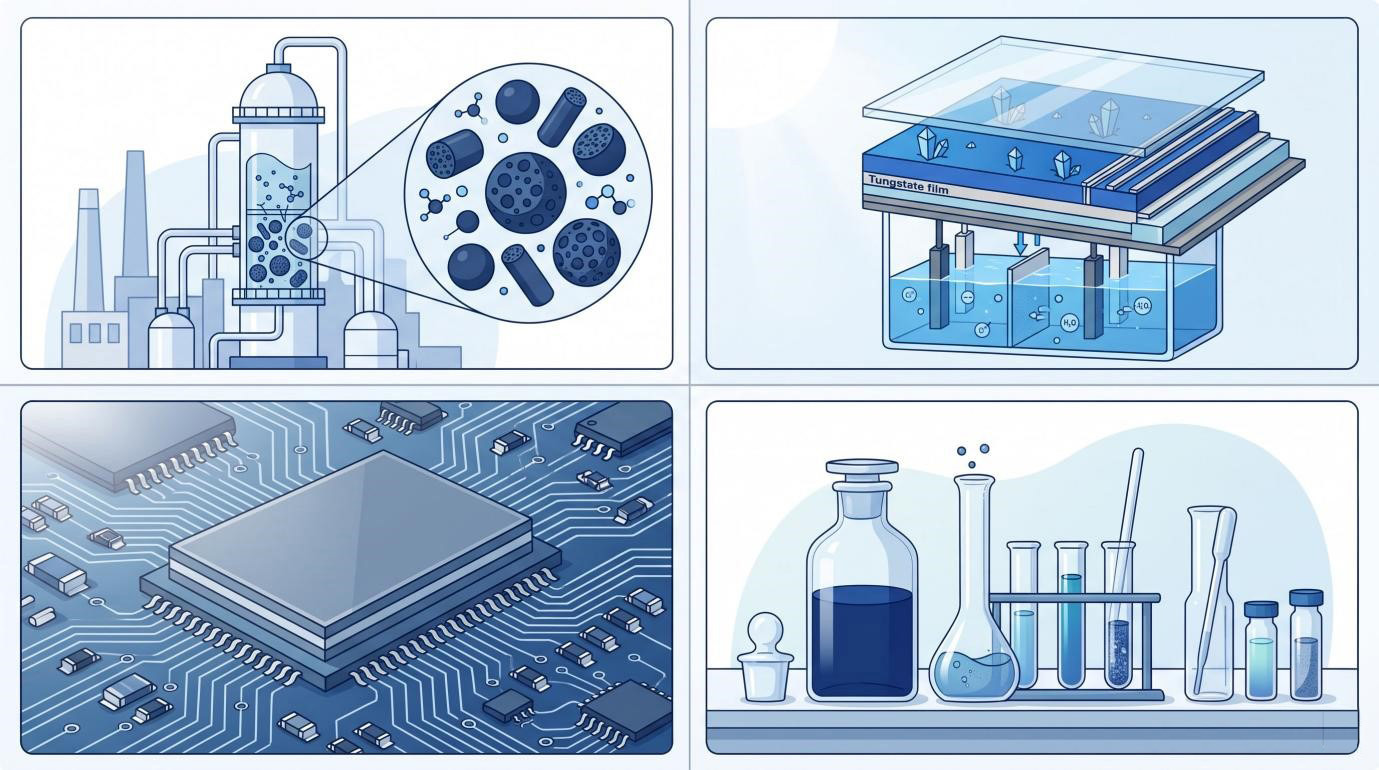
Illustration: Application areas of potassium tungstate
I. Tungsten Metallurgy and Tungsten Products
Used as an intermediate material in tungsten refining processes and as a tungsten precursor for the production of tungsten powder and other tungsten-based materials.
II. Catalysis and Fine Chemicals
Serves as a tungsten source for tungsten-based catalysts and heteropoly acid catalytic systems. It is also used in research involving oxidation and epoxidation reactions.
III. Ceramics and Electronic Materials
Used as a tungsten-containing precursor component in formulations for advanced ceramics and electronic ceramics.
IV. Electrochemistry and Energy Devices
Can be used as an electrolyte additive in photovoltaic and electrochemical battery systems. It can also mitigate separator corrosion in molten carbonate fuel cells (MCFCs).
V. Analytical Reagents and Scientific Research
Used as an analytical reagent and an alkaloid precipitating reagent, supporting laboratory-scale and pilot-scale development of tungsten-based functional materials.