In fine chemical production and biological testing, acid-catalyzed reactions such as esterification and alkylation have long relied on liquid acids, including sulfuric acid and hydrofluoric acid. These processes are often associated with equipment corrosion, numerous side reactions, and complicated post-reaction workup. Meanwhile, biological sample preparation and trace analysis require precipitants and color-developing agents with consistent batch-to?batch performance.
Functional materials that combine well?defined acidity with redox responsiveness are therefore an important area of interest for downstream applications.
Phosphotungstic acid (PTA), also known as tungstophosphoric acid or dodecatungstophosphoric acid (CAS No. 12501-23-4), is a typical heteropoly acid with a Keggin structure. Its molecular formula is H3[P(W3O10)4]·xH2O, and its molecular weight on an anhydrous basis is 2,880.05.
The product is supplied in hydrated form, and the number of waters of crystallization (x) varies with drying conditions. For example, the water content is approximately 18.3% for the 24-hydrate and 21.2% for the 29-hydrate. The actual water content should be determined by thermogravimetric analysis (TGA).
The product appears as white to pale-yellow crystals. It is hygroscopic and slightly prone to efflorescence, and should be stored in a tightly sealed container, protected from light.
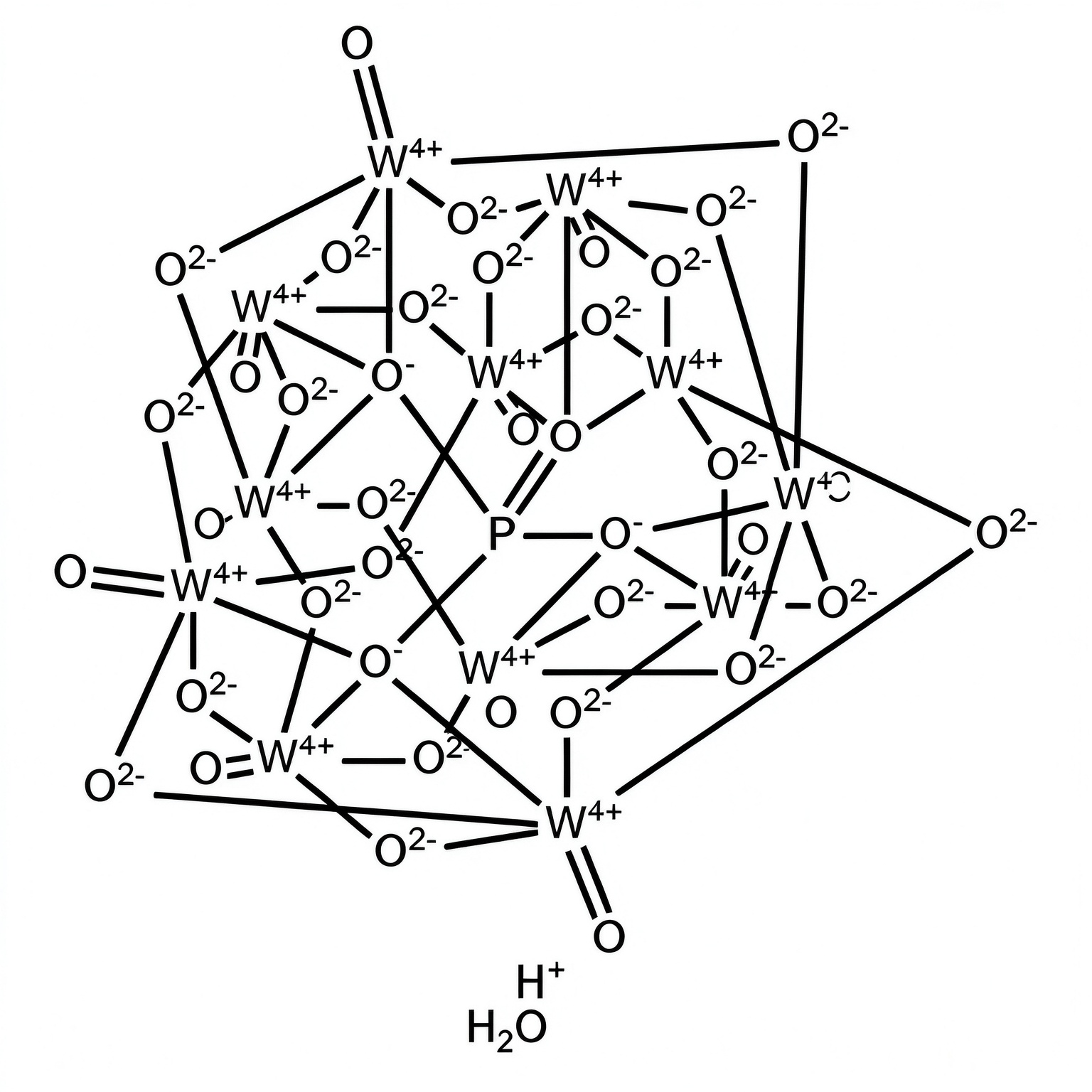
The value of phosphotungstic acid lies in its combination of acidity and redox activity. Its protons are distributed over the outer surface of the Keggin anion, contributing to its high efficiency in acid?catalyzed reactions.
However, the stability of its structural framework depends on acidity. Literature reports indicate that the Keggin structure remains stable in pure water at approximately pH 1.5 or below. At pH 1.5–2.0, it tends to transform into Dawson-type species containing two phosphorus atoms. Accordingly, sufficient acidity must be maintained.
The reduced product, known as phosphotungstic blue, exhibits strong absorption in the visible-light region, forming the basis for colorimetric determination. In the solid state, the Keggin framework remains largely intact below 550°C. Its infrared fingerprint peaks can be used to confirm the structure on a batch-by-batch basis.
Catalysis: Phosphotungstic acid can participate in reactions such as esterification, Friedel–Crafts alkylation, and olefin hydration. It can also be supported on silica to form a solid acid catalyst, offering one possible alternative to liquid-acid-based processes.
Staining and electron microscopy: It can be used as a negative staining agent for transmission electron microscopy (TEM) and is also a component of phosphotungstic acid–hematoxylin and