In ceramics, glass, and electronic ceramics, performance and energy consumption remain key concerns for manufacturers. During conventional ceramic firing, mismatches in coefficients of thermal expansion can cause products to crack. In glass melting, reducing processing temperatures while maintaining transparency is another area of ongoing industry interest. Meanwhile, demand for functional fillers in the plastics and rubber industries continues to grow, as conventional fillers often struggle to deliver both increased stiffness and heat resistance.
Barium metasilicate (also known as barium silicate; chemical formula: BaSiO3; CAS No. 13255-26-0; molecular weight: 213.41) is an important functional inorganic material.
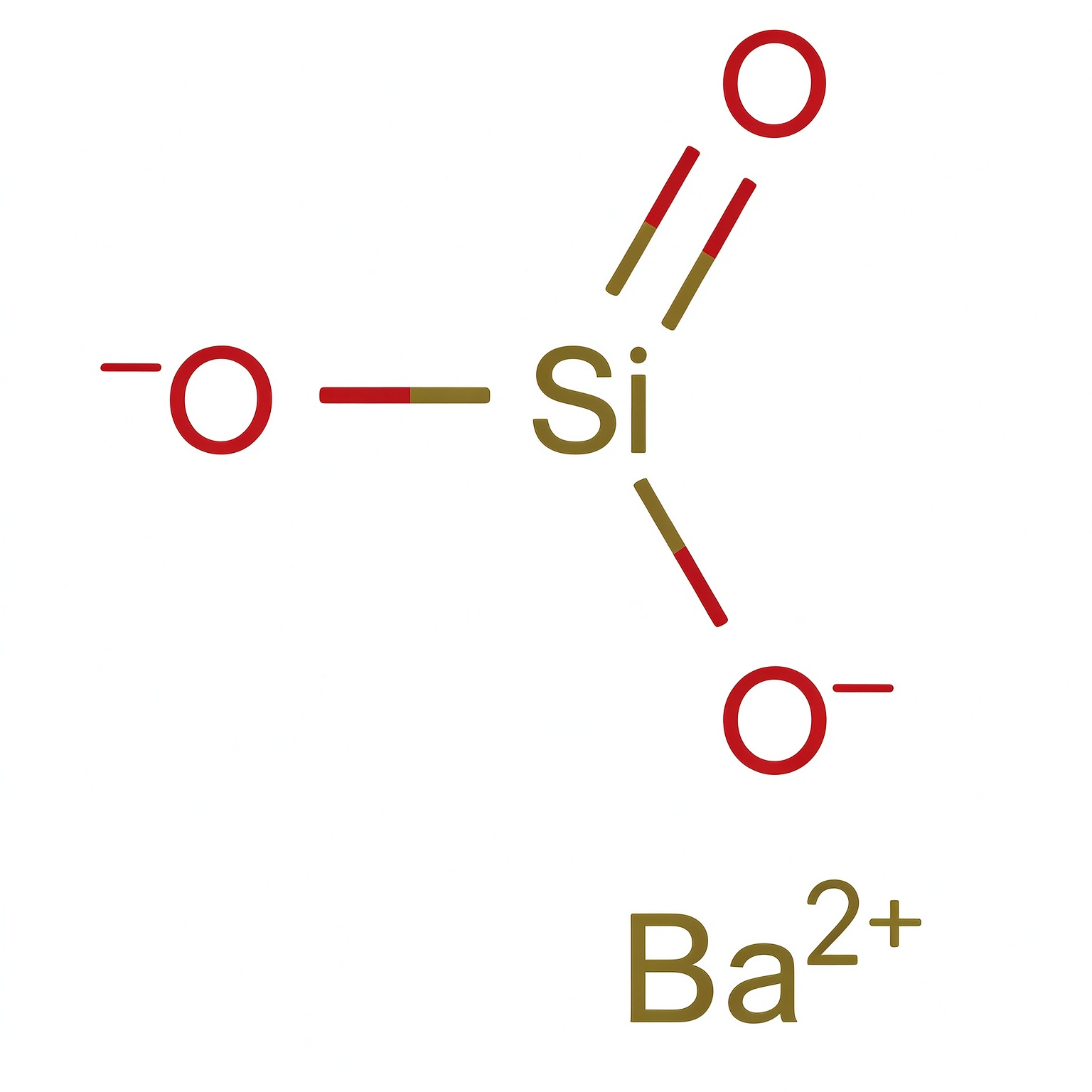
Barium metasilicate forms colorless crystals in the orthorhombic crystal system and is commonly available as a white powder. It has a melting point of approximately 1,604°C, a crystal density of about 4.4 g/cm3, and a refractive index of 1.673. A crystal phase transition occurs at approximately 990°C. It is insoluble in cold water, soluble in hydrochloric acid, and undergoes hydrolysis in hot water. Its bulk density varies with particle size and packing conditions and should be determined by measurement. The main preparation methods are solid-state reaction and the sol–gel process. It is also worth noting that the term "barium metasilicate" in some Chinese reference books may refer to the hexahydrate, BaSiO3·6H2O. This article refers to the anhydrous compound.
The value of barium metasilicate lies in its ability to modify material formulations. Its relatively high melting point and thermal stability make it suitable for refractory materials and high-temperature sealing applications. Its coefficient of thermal expansion, however, is not particularly low: literature reports a linear coefficient of approximately 12–15 × 10-6/K, which is relatively high among ceramic crystalline phases. This property is precisely what makes it useful in sealing glass-ceramics. By precipitating barium metasilicate as the main crystalline phase, the coefficient of thermal expansion of glass-ceramics can be increased to a level closer to that of oxide electrolytes and metal sealing plates. This helps prevent cracking at sealing interfaces through thermal-expansion matching. Its good chemical stability can also extend product service life. As an inorganic filler, it can improve the strength and dimensional stability of polymers.
It serves as a barium silicate component in glazes, enamels, and sintering systems, helping improve mechanical properties and thermal stability. Paper and rubber fillers are also among its traditional applications.
It is used as a component in optical glass and barium glass formulations, where its relatively high refractive index and the strong X-ray absorption of barium (Z = 56) contribute to formulation design.
It can be incorporated into dielectric ceramics and low-temperature co-fired systems. Literature reports a dielectric constant of approximately 11 and a Q × f value of approximately 6,600 for BaSiO3 ceramics, placing them within the microwave dielectric ceramics field. When doped with Eu2+, the material emits yellow light at approximately 555 nm and can serve as a phosphor host for white LEDs. It should be noted that the functional phase in X-ray scintillating glass-ceramics is barium orthosilicate, Ba2SiO42+, which is a different phase from barium metasilicate.
Guangxi Titan New Material Technology Co., Ltd. is a core enterprise in the Group‘s advanced and critical materials sector. The company focuses on the R&D, production, and technical services of advanced ceramic materials and metal-based compounds. It has established R&D and industrial operations in Nanning, Guilin, Kunming, Shanghai, and multiple overseas locations. Working with a number of universities and research institutions, the company has built an integrated R&D system spanning laboratory research through to industrialization. Its main products include high-purity fine inorganic chemicals and organometallic compounds, covering categories such as electronic chemicals and functional chemicals for optoelectronics and advanced glass materials.
Drawing on its sustained investment in R&D and global operations, Guangxi Titan can supply barium metasilicate products tailored to specific formulations in terms of crystal phase, particle size, and impurity specifications. Pricing is determined according to product specifications, packaging, and annual usage, helping downstream industries improve product performance and optimize processing.