Calcium tungstate (CaWO4) is the principal constituent of scheelite and also serves as a host material for certain luminescent materials. When grown as a single crystal, it can convert part of the energy deposited by particles or radiation into detectable light. Introducing different rare-earth ions can alter its emission color or enable temperature measurement by exploiting the temperature dependence of its luminescence intensity.
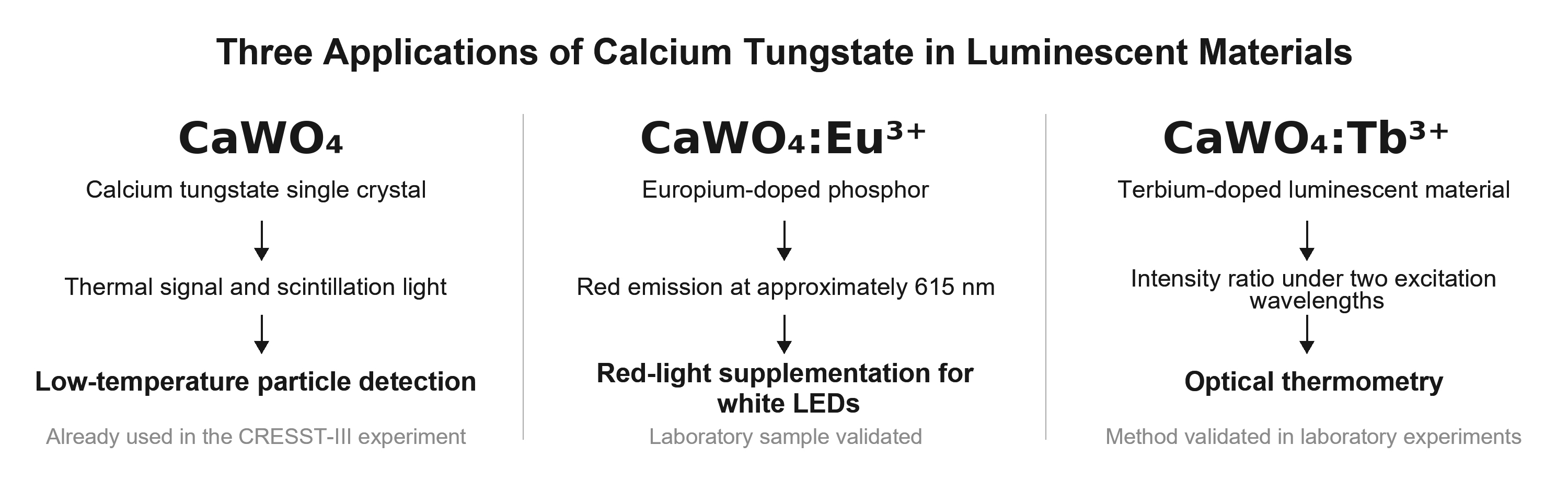
Figure 1. Three applications of calcium tungstate single crystals and rare-earth-doped materials
Calcium tungstate single crystals can emit light even without the addition of rare-earth ions. A study on single crystals grown by the Bridgman method found that, under X-ray excitation, the emission band was centered at approximately 424 nm, in the blue-violet region of the spectrum. The emission spectrum can be used to match the crystal with an optical detector, while the crystal‘s optical transparency and scintillation decay time affect the collection and readout of the light signal.
Calcium tungstate single crystals have been used as low-temperature detector targets in the CRESST-III dark matter search experiment. When particles deposit energy in the crystal, the detector simultaneously records the thermal signal and scintillation light. The ratio between these two signals helps distinguish nuclear recoils from certain radioactive backgrounds. To reduce interference from the intrinsic radioactivity of the crystals, the research team also purified the raw materials and synthesized powders, then used crystals grown from the purified materials in the experimental apparatus.
Calcium tungstate can serve as a luminescent host for trivalent europium (Eu3+). A study reported in the Journal of the Chinese Ceramic Society found that the europium-doped phosphor prepared by the researchers could be excited by near-ultraviolet light at 393 nm or blue light at 464 nm, with its main emission peak at approximately 615 nm. This red emission could potentially supplement the red component of the white LED spectrum. Before the material can be used in actual LED packaging, its conversion efficiency, luminescence performance under heating, and long-term stability still need to be evaluated.
Terbium-doped calcium tungstate containing trivalent terbium (Tb3+) can also be used in optical thermometry research. In an experiment published in Optics Express, the sample was excited separately with light at 379 nm and 413 nm, and the intensity of the same emission band was recorded under each excitation condition. The researchers first calibrated the relationship between the intensity ratio and temperature, then used this relationship to determine the temperature. Because the measurement is based on an optical signal, this method is suitable for investigating non-contact temperature measurement.
From single crystals already used in low-temperature detector systems to phosphors and optical thermometry materials still undergoing validation, the applications of calcium tungstate depend on crystal quality, doping formulations, and compatibility with devices. Guangxi Titan New Material Technology Co., Ltd. welcomes exchanges with universities, research institutions, and industry partners on the development and application of new calcium tungstate materials.