From ceramic tile bodies to reinforced plastics, wollastonite is used as an industrial raw material. Its main constituent is calcium metasilicate (CaSiO3), in which calcium, silicon, and oxygen atoms are present in a ratio of 1:1:3. Wollastonite is typically white and often forms needle-like particles when ground.
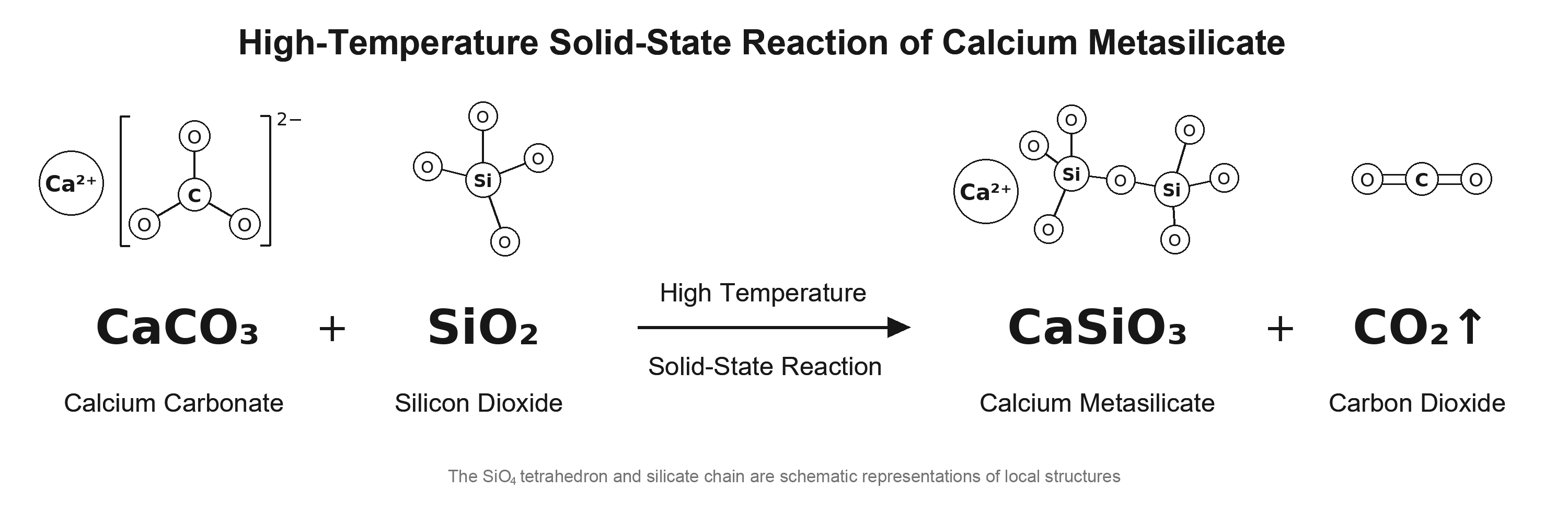
Natural wollastonite can form through the metamorphism of siliceous limestone. Industrial-grade wollastonite can be obtained through mineral beneficiation, crushing, and classification. Calcium metasilicate can also be synthesized through a high-temperature solid-state reaction between calcium carbonate (CaCO3) and silicon dioxide (SiO2), which releases carbon dioxide.
In ceramic production, wollastonite can supply calcium and silicon components to ceramic tile bodies and glazes. Under suitable formulation and firing conditions, the addition of wollastonite can help reduce firing shrinkage and lower the risk of cracking in ceramic bodies.
In plastics processing, acicular wollastonite can serve as a reinforcing filler, helping to improve the flexural properties and dimensional stability of plastic products under heat. The aspect ratio of the particles and the surface treatment method can affect the bonding between the filler and the resin, as well as the performance of the final product.
Guangxi Titan New Material Technology Co., Ltd. specializes in metal-based compounds and fine inorganic functional materials. We welcome universities, research institutions, and enterprises to engage with us in discussions and collaboration on calcium silicate selection, formulation development, and applications.