In advanced manufacturing sectors such as optoelectronics, semiconductors, precision instrumentation, and new energy technologies, thermal expansion compatibility directly affects product reliability and service life.
Conventional materials generally exhibit positive thermal expansion over a broad temperature range. Temperature fluctuations can therefore lead to stress concentration, interfacial cracking, seal failure, and even focal length drift. Precisely tuning the coefficient of linear thermal expansion (CTE) of a material system toward a target value, or even approaching zero, remains a common challenge in the design of precision equipment.
Zirconium tungstophosphate (also known as zirconium tungsten phosphate; chemical formula: Zr2WO4(PO4)2, equivalently expressed as Zr2WP2O12; molecular weight: approximately 620.2 g/mol) is a representative negative thermal expansion (NTE) inorganic functional material.
Compared with zirconium tungstate (ZrW2O8), which is susceptible to interaction with water, zirconium tungstophosphate maintains stable negative thermal expansion behavior over a broad temperature range of 25–800 °C. It exhibits no phase transition or water absorption within this temperature range and offers good chemical and thermal stability.
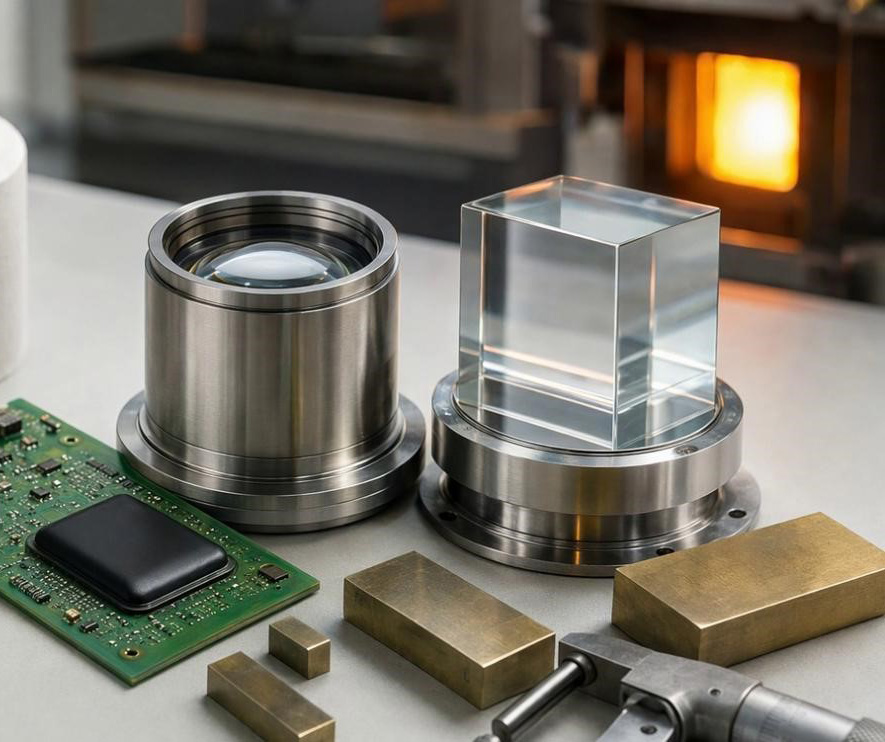
The principal value of this material lies in its stable and quantifiable negative thermal expansion.
Published literature and third-party thermomechanical analysis (TMA) and X-ray diffraction (XRD) data indicate that the average coefficient of linear thermal expansion of zirconium tungstophosphate powder is approximately -3 × 10⁻⁸ /°C, with reported values typically ranging from -2.9 to -3.4 × 10⁻⁸ /°C. Actual measured values may vary depending on particle size, densification, and testing conditions.
This material can be incorporated into composite systems with polymer resins, glass, ceramics, and other matrix materials. By adjusting the filler loading, the overall coefficient of linear thermal expansion of the composite can be tuned toward a lower value, enabling the design of compatible systems combining a negative thermal expansion phase with a positive thermal expansion matrix.
Zirconium tungstophosphate is primarily used as a functional negative thermal expansion filler.
Electronic and Optoelectronic Packaging: Incorporated into epoxy encapsulants, potting compounds, and sealing materials to reduce the coefficient of linear thermal expansion of cured materials and mitigate thermal mismatch between semiconductor chips and substrates.
Precision Optics and Metrology: Used in lens mounts, spacer rings, precision gauge blocks, and reference standards to suppress temperature-induced focal length variations and measurement deviations.
Glass and Ceramics: Used as a thermal expansion-modifying component in sealing glasses, specialty glasses, and ceramic composite systems to improve sealing performance and dimensional reliability.