Ceramics are widely known for being brittle—a porcelain bowl shatters when dropped, and a ceramic tile cracks when struck. Yet in April 2025, a research team at the University of Houston developed a ceramic material that can bend and withstand loads. By combining origami geometry, 3D printing, and a flexible coating, the team enabled one of the most brittle classes of materials to bend without breaking.
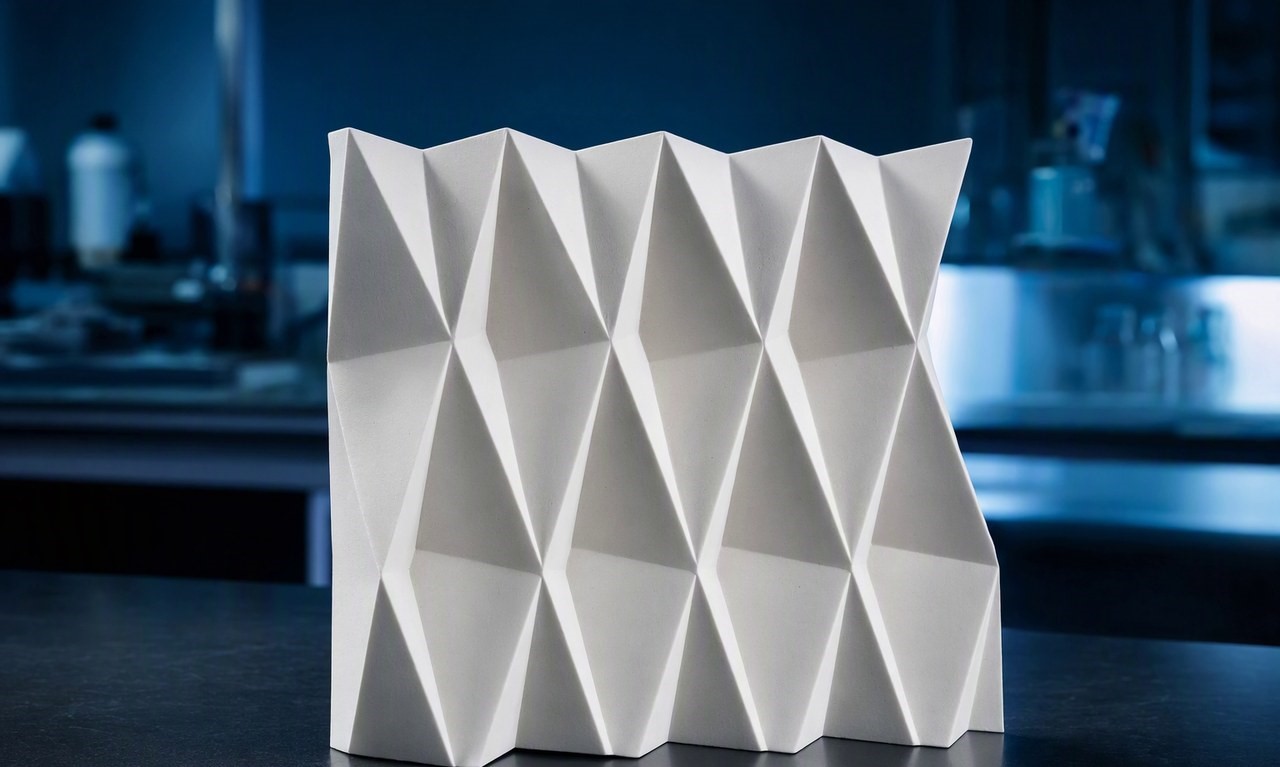
Ceramics have traditionally been closely associated with brittleness: they crack easily under stress and break when bent. In a study published in the international journal Advanced Composites and Hybrid Materials, a team led by Maksud Rahman, an assistant professor in the Department of Mechanical and Aerospace Engineering at the University of Houston, presented a new approach.
The researchers first used vat photopolymerization 3D printing with a ceramic slurry to fabricate a ceramic structure featuring a Miura-ori folding pattern. The structure was then sintered at temperatures of up to approximately 1,270°C, giving it strength comparable to that of conventional ceramics. Next, a soft polydimethylsiloxane (PDMS) elastomer coating was uniformly applied to every ridge and fold through vacuum infiltration coating. The coating was only 75–100 μm thick.
The difference became clear under mechanical loading. In three-directional compression and cyclic loading tests, uncoated conventional ceramic structures quickly cracked and underwent brittle collapse. By contrast, the coated origami ceramic could withstand repeated compression and elastically recover its shape. The improvement in toughness was most pronounced along the weakest loading direction. Instead of failing catastrophically, the structure deformed locally in a stepwise manner, absorbing impact energy layer by layer.
Key figures
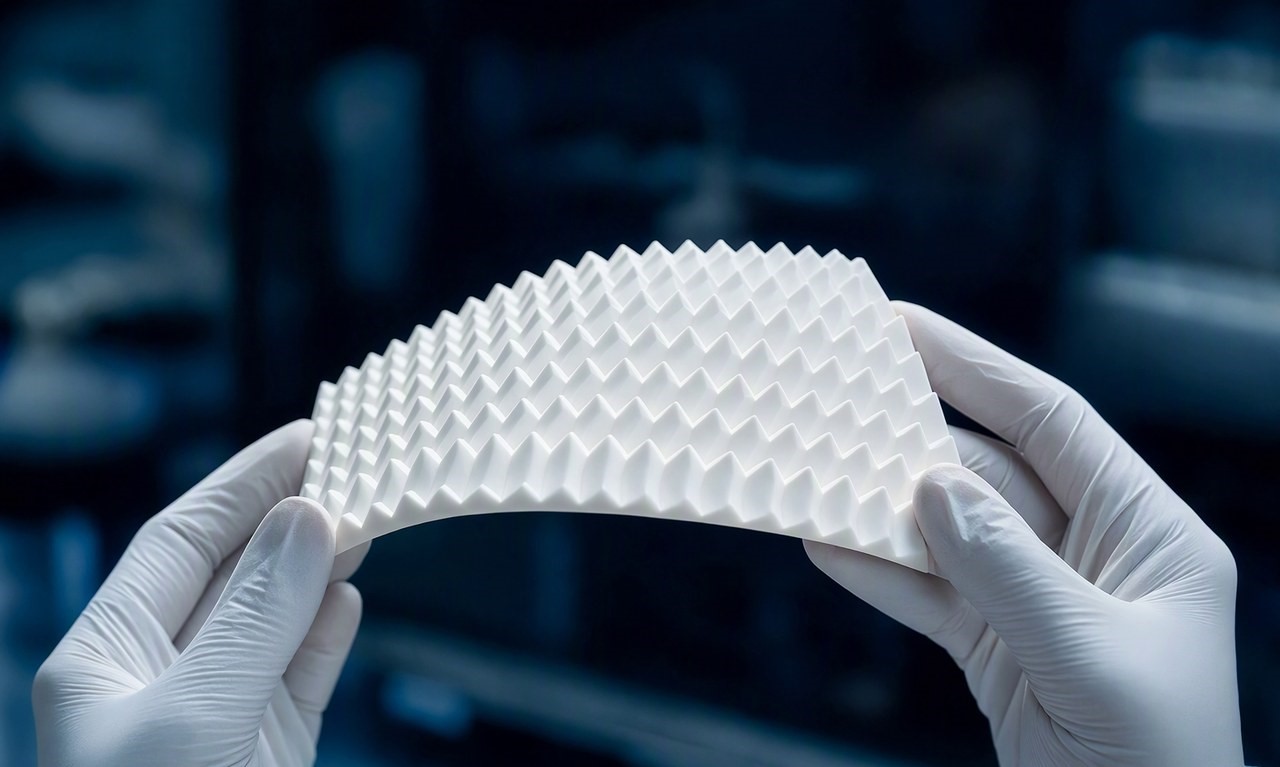
Behind this “soft armor” are two complementary protective mechanisms.
The first is geometry. The Miura-ori pattern, proposed in 1970 by Japanese astrophysicist Koryo Miura, is one of the best-known periodic folding patterns in origami geometry. Its zigzag crease pattern distributes stress across the structure, preventing cracks from concentrating in a single location. This folding design has also been used in deployable solar panels for space applications.
The second is the coating. The ceramic framework provides rigidity, while the PDMS coating contributes toughness. It redirects stress away from vulnerable ridges and helps bridge cracks and prevent their propagation. Approximately 91% of the structure‘s volume consists of ceramic. The brittle framework and soft interfacial layers work together in a way that is reminiscent of nacre, or mother-of-pearl. Nacre‘s layered architecture of hard platelets and soft organic films is precisely what enables a brittle material to resist impact.
Every improvement in ceramic performance—from rigid and brittle to flexible and deformable—depends on advances in fundamental raw materials and processing technologies.
As cutting-edge research around the world continues to expand the application boundaries of ceramic materials, companies in China are also building capabilities in the advanced ceramics sector, supporting industrial upgrading through core technologies and customized services. Guangxi Titan New Material Technology Co., Ltd. is one of the companies actively developing its expertise in this field.
As a core enterprise of Titan New Materials Group, Guangxi Titan serves as a key platform for the Group‘s advanced and critical materials sector. It is positioned as a metal-based compound custom synthesis center and an R&D and production base for new materials. With the goal of becoming the world‘s largest provider of custom synthesis services for metal-based compounds, the company has long focused on the R&D, production, and provision of technical services for advanced ceramic materials. It has developed an integrated supply capability covering everything from basic raw materials to application solutions.
Strong R&D capabilities are essential to a materials company‘s long-term development. Guangxi Titan follows an innovation model built on industry–university–research collaboration. It has established R&D and industrial operations in Nanning and Guilin in Guangxi, Kunming in Yunnan, Shanghai, as well as Vietnam, the United States, and Brazil. The company works closely with universities and specialized research institutions in China and abroad, including Guilin University of Technology, Nanning Normal University, and Kunming University of Science and Technology. Together with its partners, it has established R&D platforms such as the Guilin University of Technology Joint Laboratory, the Nanning Precious Metal Chemicals Laboratory, and the Silver-Based New Materials Laboratory.
At the same time, the company is accelerating the development of pilot-scale platforms, including an Advanced Ceramic Materials R&D Center, an Organometallic Research Center, and a Precious Metal Catalyst Research Center. These are supported by semi-industrial-scale experimental platforms such as the Tin Chemical Engineering Technology Research Center and the Lithium, Cesium, and Rubidium Chemicals Development Experimental Base. Together, these facilities are intended to help bridge the gap between laboratory technologies and industrial applications.
In terms of its product portfolio, Guangxi Titan has developed core product lines to address the needs of the advanced ceramics industry. These include high-purity oxides for engineering ceramics, electronic ceramics, and catalysts; metal and metal oxide nanopowders; and custom R&D services for novel compounds. These products provide essential raw material support for innovation in downstream ceramic materials.
Building on this foundation, the company‘s portfolio also covers high-temperature refractory metal compounds, fluorides for optoelectronics and advanced glass, organometallic compounds, precious metal compounds for pharmaceutical applications, precious metal recovery, environmentally friendly smart materials, and advanced alloy materials. Its offerings are organized into three core categories—inorganic compounds, organic compounds, and precious metal compounds—and four business divisions: pharmaceutical raw materials, agrochemicals, catalysts, and reagents. This portfolio is designed to meet customized needs across high-end sectors such as new energy, optoelectronics, semiconductors, and biomedicine.
With a global market focus, Guangxi Titan continues to advance its international operations strategy, establishing production bases in Vietnam, the United States, and Brazil. The company is also developing an online B2B trading platform for new materials that integrates product showcases, online consultation, supply-and-demand matching, technical exchanges, and order coordination, providing global customers with an efficient and convenient channel for business engagement.
From frontier exploration of origami-inspired ceramic structures to the industrial application of advanced ceramic raw materials, materials researchers and industry participants around the world are continuing to expand the possibilities of ceramic materials. Guangxi Titan will continue to deepen its work in metal-based compounds and advanced ceramics, focusing on technological innovation and customized services while working with customers worldwide to explore further possibilities in materials science.