How can mineral particles that look similar but have different densities be separated? One approach is to place them in a heavy liquid with an adjustable density. Cesium tungstate (Cs2WO4) is a water-soluble inorganic tungstate that can be prepared as a high-density aqueous solution for mineral sink–float separation. It has also been investigated as a doping precursor in experimental studies of luminescence in cesium iodide crystals.
Cesium tungstate consists of cesium ions and tungstate ions, with an atomic ratio of cesium to tungsten of 2:1. Tungsten has an oxidation state of +6. At room temperature, its anhydrous crystals have an orthorhombic crystal structure, which can be verified by powder X-ray diffraction (XRD).
Cesium tungstate is readily soluble in water, allowing the density of the resulting solution to be adjusted by varying its concentration. Commercial cesium tungstate heavy liquids can reach a density of approximately 3.2 g/cm3 at 20 °C. In practical separation processes, the working density is set according to the densities of the target minerals.
The powder readily absorbs moisture and should therefore be sealed promptly after sampling and stored in a dry environment. When preparing the solution, its density can be remeasured at the working temperature to minimize deviations caused by moisture absorption in the raw material or solvent evaporation. Adequate ventilation should be maintained during powder weighing and transfer to minimize dust generation, and appropriate protective measures should be taken in accordance with the safety data sheet (SDS).
In mineral analysis, sink–float separation can be used to concentrate heavy mineral fractions for subsequent identification. When the density of the heavy liquid is adjusted to a value between the densities of two types of particles, those with densities lower than that of the liquid float, while those with higher densities sink. The two fractions can then be collected separately to obtain two distinct sample groups.
Suppliers in Canada already provide this type of heavy liquid to mineralogy and metallurgical laboratories. In practical separation processes, particle size and the degree of mineral liberation also affect the results. When lighter and heavier minerals remain intergrown, the particles are separated according to their overall density.
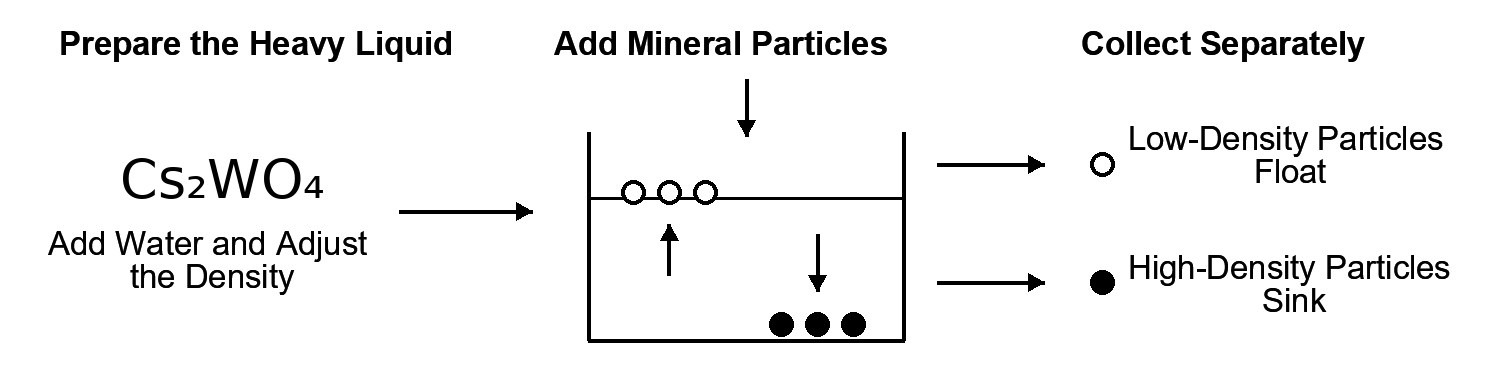
Figure 1. Schematic illustration of the sink–float separation principle using an aqueous cesium tungstate solution. Hollow and solid circles represent particles with relatively lower and higher densities, respectively.
In scintillation material experiments, researchers have used cesium tungstate to introduce tungstate-related impurities into cesium iodide (CsI) crystals. Within an experimental temperature range of 200–420 K, the doped crystals exhibited luminescence at approximately 415 nm when excited by a pulsed electron beam. This result was obtained from doped cesium iodide samples and represents a laboratory-scale investigation of luminescence.
Hexagonal cesium tungsten bronze, such as Cs0.32WO3, which is used for near-infrared shielding, has a different composition and crystal structure from cesium tungstate.
The use of cesium tungstate in different processes requires matching the raw material specifications with actual operating conditions. For mineral sink–float separation, a practical approach is to first characterize the raw material‘s crystal phase, measure the density of the heavy liquid at the working temperature, and assess its stability. The separation performance can then be evaluated using actual mineral samples.