Cobalt tungstate (CoWO4) can serve as a candidate material for blue inorganic pigments when prepared in crystalline powder form. When fabricated as a thin film on a conductive substrate, it can also be used to investigate ways of promoting anodic oxygen evolution in alkaline electrolytes.
Cobalt tungstate consists of cobalt, tungsten, and oxygen, with an atomic ratio of 1:1:4. Under ambient pressure, its typical crystal phase adopts a monoclinic wolframite-type structure with the space group P2/c. In the crystal structure, both cobalt and tungsten are coordinated by six oxygen atoms, forming distorted cobalt–oxygen and tungsten–oxygen octahedra.
Cobalt tungstate has low solubility in water, and deep-blue solid samples for research purposes are already available. During material selection, X-ray diffraction (XRD) can be used to verify the crystal phase, followed by powder colorimetry or electrochemical evaluation of thin-film samples, depending on the intended application.
When handling cobalt tungstate powders, dust generation should be controlled to avoid inhalation or contact with the eyes and skin. Appropriate protective measures should be taken in accordance with the safety data sheet (SDS) of the product being used.
In one study on anodic oxygen evolution, cobalt tungstate thin films were deposited on stainless steel plates using a layer-by-layer ion adsorption and reaction method. The resulting films consisted of nanocrystals, while surface porosity provided a larger contact interface between the film and the electrolyte.
When an electric current is applied, hydroxide ions are oxidized at the anode to produce oxygen and water, with electrons flowing through the conductive substrate into the external circuit. In a 1 mol/L potassium hydroxide (KOH) solution, the experimental electrode exhibited an oxygen evolution overpotential of 330 mV at a current density of 100 mA/cm2
Overpotential refers to the additional potential required to drive an electrochemical reaction at a given rate. This value applies specifically to the tested thin-film electrode. The overall energy consumption and long-term service life still need to be evaluated in a complete electrolysis system.
In pigment research, two groups of samples prepared using the co-precipitation method and the polymeric precursor method, respectively, were both subjected to heat treatment at 800 °C for 4 hours. Both groups formed monoclinic cobalt tungstate, although differences were observed in crystal grain size and morphology. Colorimetric measurements also revealed distinct shades of blue.
Powder testing results can provide an initial basis for pigment screening. For coating applications, however, dispersibility and the resulting coating color still need to be evaluated in actual formulations. For ceramic glaze applications, the crystal phase and color after firing must also be verified.
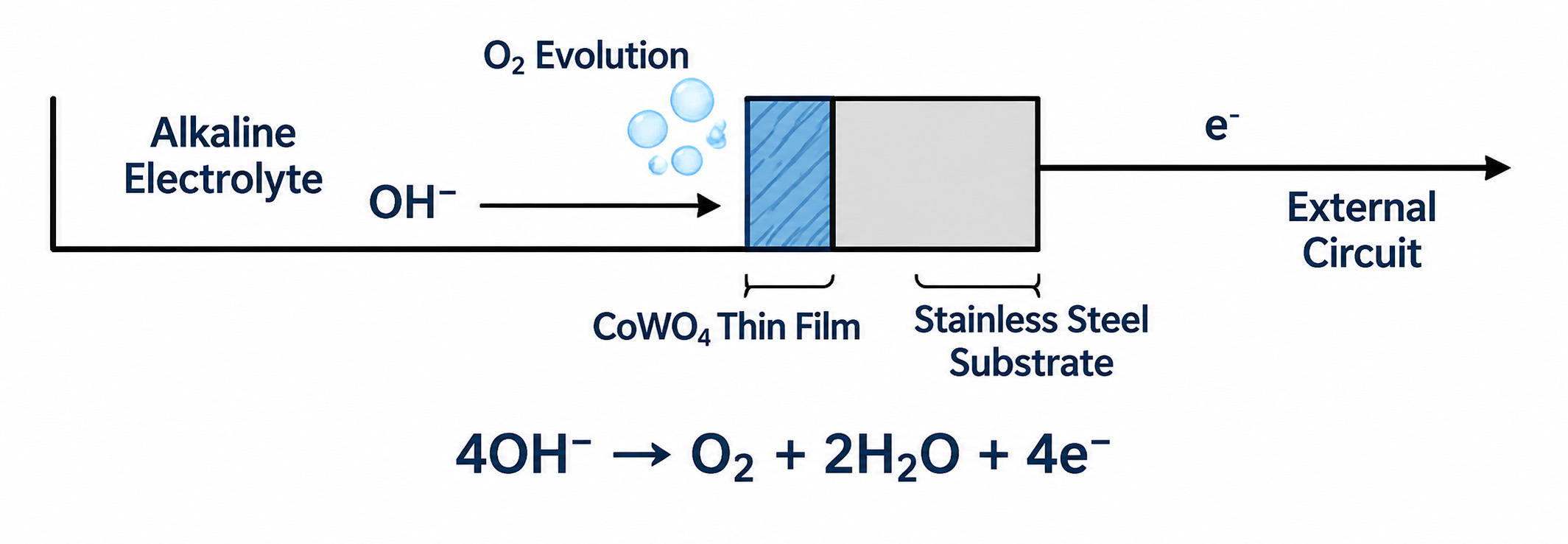
Figure 1. An anode coated with a cobalt tungstate thin film in contact with an alkaline electrolyte, where oxygen is evolved. The reaction equation in the diagram represents the alkaline oxygen evolution half-reaction.
Cobalt tungstate with the same crystal phase can be prepared either as a powder or as a thin film on a conductive substrate. Material selection should therefore take into account the evaluation of color and electrode performance under their respective processing conditions.
Guangxi Titan New Material Technology Co., Ltd. focuses on custom synthesis of metal-based compounds and R&D of advanced ceramic materials. We welcome scientific research institutions and industry partners to engage with us in discussions and collaboration on cobalt tungstate crystal phase characterization, powder selection, and coating sample validation.