Shining light onto a copper tungstate thin film can generate a measurable photocurrent under an applied bias. Copper tungstate nanoparticles can also be used to develop devices that respond to changes in humidity. Copper tungstate (CuWO4) is the material corresponding to COX-62 in Guangxi Titan New Material Technology Co., Ltd.‘s tungsten-based composite oxide product portfolio. These two experimental applications take advantage of its visible-light response and the adsorption of water vapor on particle surfaces, respectively.
Copper tungstate consists of copper, tungsten, and oxygen, with an atomic ratio of 1:1:4. Under ambient pressure, it typically crystallizes in a triclinic phase with a distorted wolframite-type structure. Both copper and tungsten are surrounded by six oxygen atoms, forming coordination octahedra, with the copper–oxygen octahedra elongated along one direction. The material is insoluble in water, making it suitable for studies of aqueous interfaces and surface adsorption in the form of solid thin films or particles.
Copper tungstate is an n-type semiconductor. Electrodeposited polycrystalline films have an indirect band gap of approximately 2.25 eV, lower than that of tungsten trioxide (WO3), which was used as a reference material in the same experiment. This allows copper tungstate to absorb visible light at longer wavelengths. When the thin film absorbs light, electrons and holes are generated. Some of these charge carriers recombine before they can be collected or participate in reactions. Therefore, evaluating a photoanode also requires assessing how effectively these charges can be separated and transported.
When handling copper tungstate powder, dust generation should be controlled to avoid inhalation or contact with the eyes and skin. Appropriate protective measures should be taken in accordance with the safety data sheet (SDS) for the product being used.
In photoelectrochemical water oxidation, a copper tungstate thin film serves as the light-absorbing layer of a photoanode. Photogenerated holes reach the interface between the film and the electrolyte, where they can participate in water oxidation to produce oxygen. Meanwhile, electrons pass through the conductive substrate and enter the external circuit.
In an experiment conducted at the University of Michigan, an electrodeposited copper tungstate thin film was tested under simulated sunlight in a phosphate buffer solution at pH 7. At an applied potential of +0.5 V versus an Ag/AgCl reference electrode, a photocurrent density of 0.16 mA/cm2 was measured. The hydrogen production efficiency and operating lifetime of the complete system require separate evaluation.
In a humidity-sensing prototype, copper tungstate nanoparticles serve as the humidity-sensitive layer. The adsorption and desorption of water vapor on the particle surfaces are accompanied by changes in the electrical signals of the device. One experimental prototype was tested at room temperature over a relative humidity range of 11% to 97%, demonstrating a response to changes in humidity. Further evaluation of temperature effects, long-term drift, and batch-to-batch consistency is still needed for practical applications. Both cases remain at the experimental validation stage.
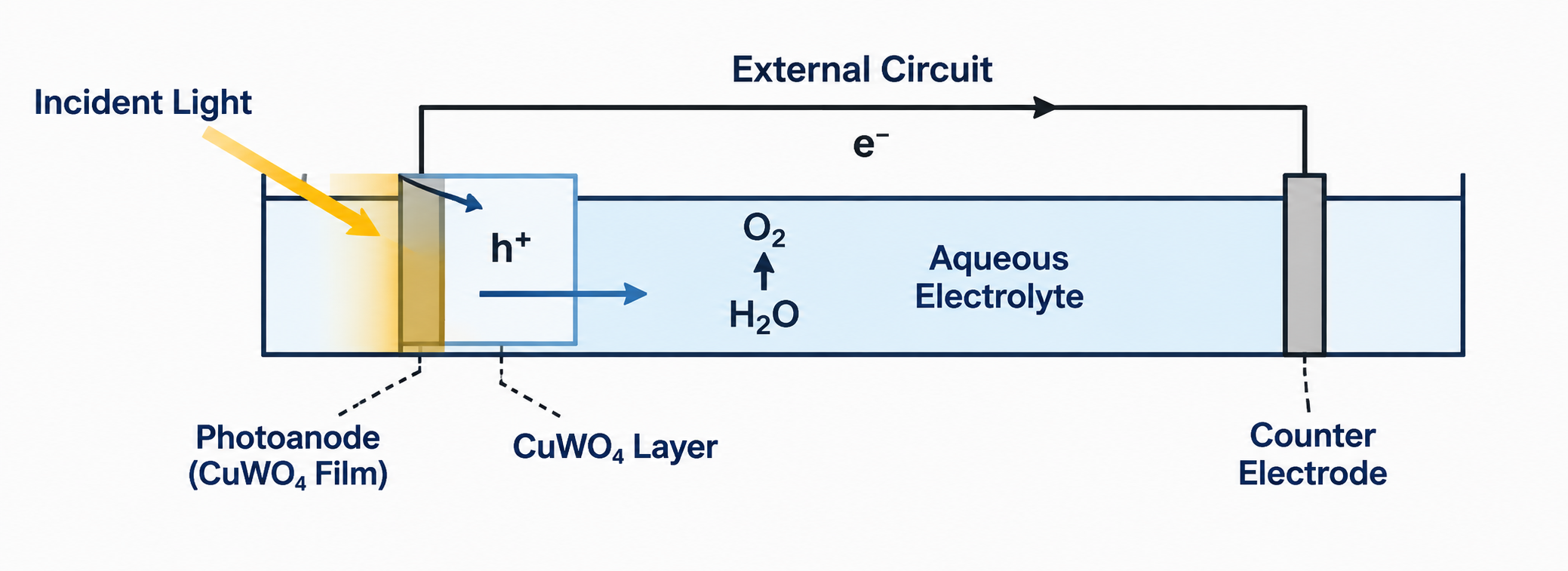
Figure 1. Mechanism of water oxidation at a copper tungstate photoanode. Holes (h+) participate in oxygen evolution at the electrolyte interface, while electrons (e-) flow through the external circuit to the counter electrode.
Copper tungstate powder is available in research-grade specifications. From powder to device, both charge transport in thin films and water vapor adsorption on particle surfaces are influenced by material form and processing conditions.
Guangxi Titan New Material Technology Co., Ltd. focuses on custom synthesis of metal-based compounds and R&D in advanced ceramic materials. We welcome universities, research institutions, and industry partners to engage with us in discussions and collaboration on crystal phase characterization, sample selection, and device validation involving copper tungstate.